
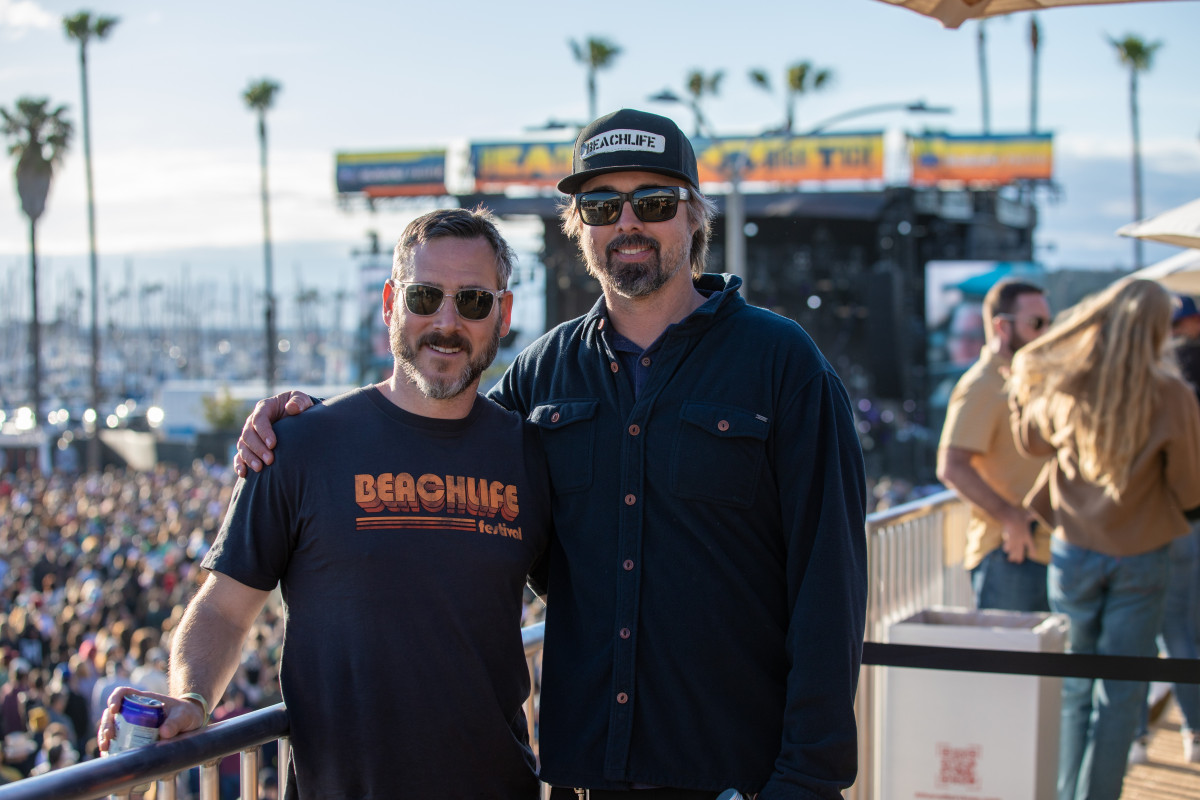
Above Photo – From left: Longtime friends and cofounders of BeachLife Rob Lissner and Allen Sanford at the Redondo Beach waterfront festival. Photo credit: JP Cordero
On March 26, the South Bay Cities Council of Governments (SBCCOG) will host its 26th annual conference, bringing together South Bay communities to address emerging issues facing the subregion. While the South Bay has always been the home of great beaches, fine art and culture, it is now facing unprecedented opportunities for exposure on the world stage as it serves as a major axis point for upcoming major events, such as the FIFA World Cup 2026, Super Bowl LXI, and the 2028 Summer Olympic and Paralympic Games. This year’s General Assembly will explore the South Bay’s transformation into a hub for sports and entertainment and the impact this evolution is having on the economy and environment.
Allen Sanford, a South Bay native and entrepreneur who created BeachLife Festival and recently opened California Surf Club in The Waterfront, Redondo Beach will be a speaker at the event. He shares his insights about how sports and entertainment are shaping the South Bay.
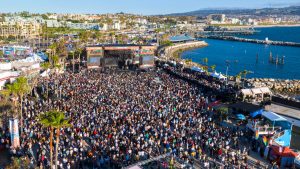
South Bay native and entrepreneur Allen Sanford created BeachLife Festival (pictured) and recently opened California Surf Club in The Waterfront, Redondo Beach. He will be a speaker at the March 26, 2026 General Assembly. Photo credit: JP Cordero
Q: Why did you believe the time was ripe to bring a major music festival like BeachLife here?
A: Growing up in the South Bay, I watched my parents go to The Strand [former club in Redondo Beach] and enjoy top-level music, so I understood the demand early. Yet most of the sports and entertainment we experienced as a family meant driving out of the South Bay. Everyone likes to be entertained and our hypothesis was that putting music together for the enjoyment of the beach community would be interesting to the public. This was further fueled by an experience at the Hollywood Bowl in 2016, going to see Paul Simon, whereby I spent a few hours in traffic, finally got to my seat halfway through the show and realized that the juice was no longer worth the squeeze. That night served as the beginning of the road toward BeachLife.
Q: What makes the South Bay appealing for event and venue developers?
A: The South Bay is unique to Los Angeles and a unique differentiator in the LA28 campaign. The music and sporting communities have a plethora of options related to large, corporate arenas in our subregion. However, boutique and curated outdoor events—with the beach and culture Los Angeles is known for as the backdrop—are unique and in short supply but have a great demand. Additionally, brands that desire to make a meaningful and genuine impact on potential consumers have a hard time doing that in a corporate, indoor arena environment. As we contemplate millions of fans visiting Los Angeles for the Olympics, our thesis is that a large majority are there for the party … and the South Bay is what tourists imagine Los Angeles to be. My wife, born and raised in Germany, continues to remind me that she grew up watching subtitled episodes of Baywatch, dreaming of coming to Southern California to see the beaches, ocean, palm trees, skateboards and surfboards. That anecdotal evidence has inspired much of our forward movement.
 Q: The South Bay has flown under the radar for a long time, with its proximity to but also distance from higher-profile neighbors such as the City of Los Angeles and Hollywood. What challenges and opportunities did this pose for you when creating BeachLife?
A. The biggest challenge for me is a cultural challenge. When you have experienced something amazing and beautiful like the South Bay, my initial reaction is to want to be inclusive and share that experience. However, my secondary reaction is to protect that experience and make sure it doesn’t change or get ruined with an increase in volume. I believe BeachLife has been successful in addressing this. We have not increased our footprint or forgotten our attention to detail over the years. The opportunity is obvious—though I’m subjective. As a born and bred Angelino raised in this area, I truly believe we have one of the best coastal living areas in the world, so it’s easy for me to see the opportunity, however subjective that may be.
Q: Now with so many major venues, the South Bay holds a fair share of the cards when it comes to hosting the subregion’s major entertainment and sporting events. How can the South Bay leverage this to attract tourism and recognition on the global stage?
A: I think it’s imperative that the South Bay understands its power in banding together and creating a collective rather than individual win. More specifically, if communication is sparse and each city in the South Bay operates as an island, the success will be incremental. If the cities can achieve communication and start dreaming bigger collectively, I believe the South Bay could play a major part of the fan experience in Los Angeles in 2028.
Q: With this higher profile, will we see more attractions in the future, like the West Harbor development that’s coming to the San Pedro waterfront?
A: I believe that with success in the South Bay, more entrepreneurs will learn about the area and try to capitalize on the opportunity, Having spent my career in the South Bay, though, I believe there are some significant obstacles that many people don’t or won’t see without having the direct experience of building in the South Bay. So yes, I think we’ll see an increase in business endeavors, but I do believe that the South Bay has limited capacity.
Q. Public transit is not widely used in the South Bay. How has this impacted your event?
A: I’m not a transportation expert, but the lack of public transportation affects all of Los Angeles and has since I was a kid. It creates “borough” type environments, and this has positive and negative effects. With BeachLife, we understood the community’s need, for example, for bike and skateboard parking at the festival, which largely ameliorated any parking or traffic concerns the public initially had.
Q: How does BeachLife impact the local economy and that of the greater South Bay?
A: BeachLife does a third-party economic study annually around this question, and I’m always humbled at the results. We bring two types of currency to Redondo Beach and the greater South Bay: 1) real dollars (eight figures) that are invested into the community through consumer spending, hotel tax, employment increases, etc., and 2) intangible earned media value by spotlighting the South Bay as a beautiful area. Just recently, In-N-Out Burger, a major California corporation, brought a large event to Redondo Beach as a result of the owner attending BeachLife several times and seeing what was possible. Word of mouth is one of the most underrated growth engines out there.
Q: What has been the local government’s role as an encourager and a regulator of your business endeavors? How has BeachLife’s host city Redondo Beach supported you? Are there improvements that would help?
A: Traditionally, government has been viewed as an impediment or obstacle to event success. Two people believed in BeachLife initially, which truly helped me realize the vision: Bill Brand, former mayor of Redondo Beach, and Mike Witzansky, the current city manager. When I first came to Redondo Beach with this idea, the city was in turmoil surrounding coastal development, and BeachLife served as a lightning bolt to inspire imagination on what the Harbor could be other than a large parking lot. Though confidence was not high that BeachLife would succeed initially, these two individuals, along with former chief of police Keith Kauffman and deputy public works director Mike Klein, helped us reduce obstacles—not create them—by starting from a place of “yes.” Coming back from COVID, it truly felt like the City of Redondo Beach was a business partner helping a struggling partner come back from nothingness, and as a result we were able to continue building momentum into what BeachLife is today.
Fast-forward: Today there is a different council, a different city staff and a new historical perspective, but we continue to put forth our best effort to be great partners with the community, delivering a unique experience that has come to be loved by the South Bay. The key to success really is municipalities creating mutually beneficial partnerships as opposed to short-term vendor relationships.
Q: As a business owner, are you doing anything to prepare for the coming 2028 Summer Olympic and Paralympic Games?
A: Yes. The South Bay has an unbelievably unique opportunity to play a major role in the 2028 Olympics. My memory of being a kid and watching the torch run through the South Bay in 1984 continues to inspire me to play some part in one of the greatest events in the world. The reason I’m doing this interview and participating with this body is that I want to capture the imagination of the local city councils and public figures. Now is the time for planning, communication and partnering—and I don’t see nearly enough of it right now. Our businesses are already preparing for the Olympics and have been in communication with LA28, and I credit Mayor Light of Redondo Beach for pushing the initiative forward. But I am not in a position to control the outcome of the cities in the South Bay—only to advocate that now is the time to act. The window for opportunity is small, and the complexities are significant. Only those who fully embrace the opportunity and work toward success will see the fruits of their labor.
Q: Are you excited about the future of sports and entertainment in the South Bay?
A: It depends on whether it fits the character and soul of the South Bay. Bringing beneficial economics and attention to the South Bay without preserving its communal fabric is self-defeating. At the same time, living in denial that change is not only inevitable but needed is equally destructive to the community, and those who fight against all forms of growth and change usually end up opening the door to the worst type of change they tried to prevent. Most of us love sports and entertainment and would love to see more of it—in a quality, measured and optimal form. Threading that needle is difficult, but I believe it’s possible, and I look forward to participating and assisting in this progression. •
Register today to hear Sanford and South Bay thought leaders speak at the March 26 General Assembly.